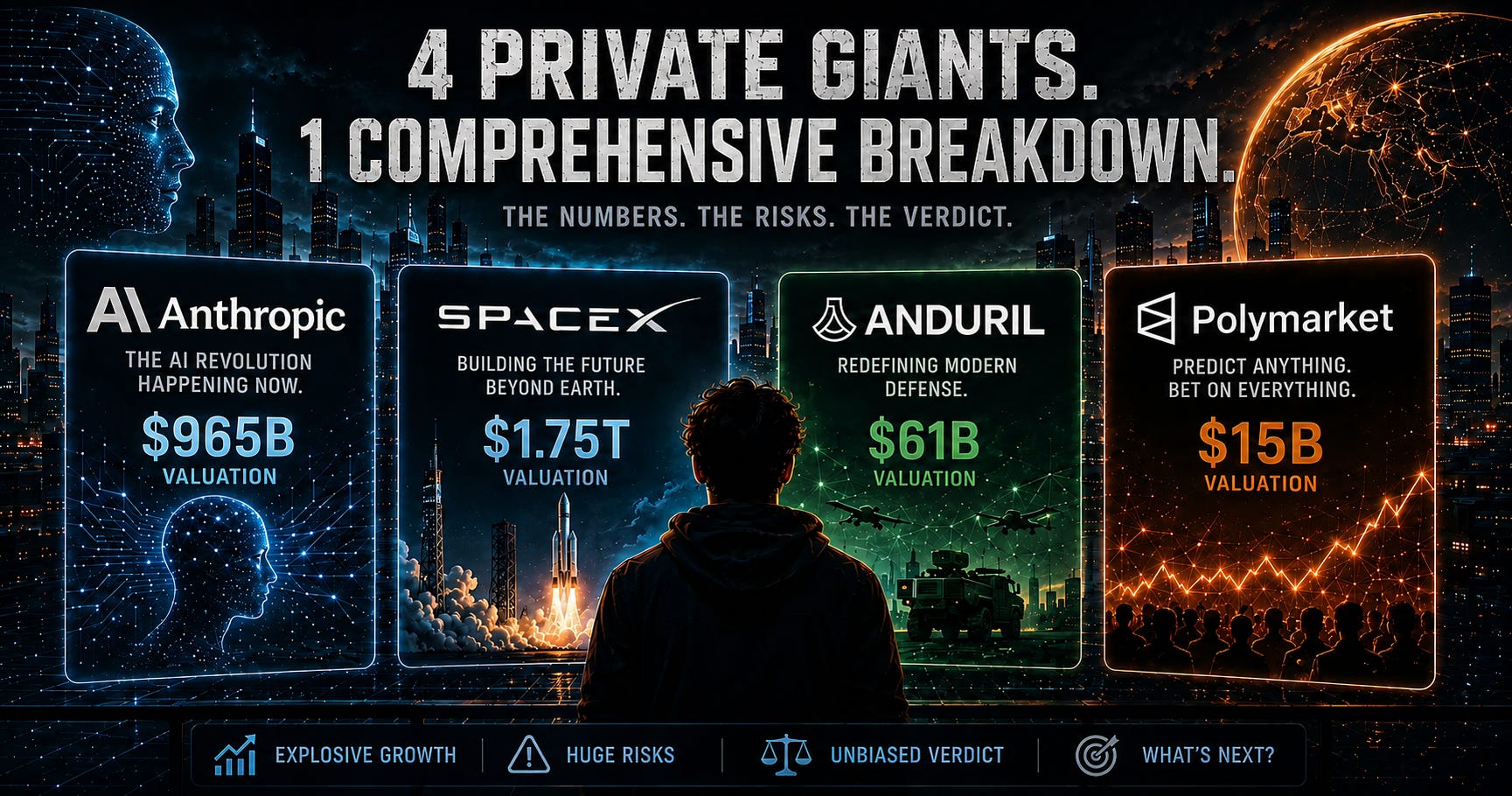
I know that for many of you, the most valuable resource is your time. If you don’t have 25 minutes weekly to pore over in depth research, or if you flagged one of my posts as “need to read” and never had the time, this post is for you.
This post is going to be short, and include summaries of every company that I have covered in May. Hours of research on Anthropic, SpaceX, Anduril and Polymarket will be condensed into one brief article. Each one of the recaps should take about 2-3 minutes to read, the whole post will be under ten minutes.
Anthropic: May 4th.
The Core Thesis:
Anthropic is the developer of the LLM Claude, built to be both the best and most ethical AI model. Despite the company only being founded in 2021, Claude has quickly become one of the fastest growing LLM models, being the preferred LLM choice among enterprise users. Anthropic has proven that users will pay a premium for the highest quality and safest LLM model driving historic revenue expansion reaching $45 billion in ARR in only their fifth year after being founded.
The Eye Opening Numbers:
2023: $150 million —— 2024: $1 billion —— 2025: $9 Billion —— February 2026: $14 billion —— April 2026: $30 billion —— May 2026: $45 Billion.1
$19 billion in R&D costs in 2026 alone.
Charge per Million Tokens: Anthropic, $5.00, OpenAI $1.25, Google $1.25.
Revenue per Paid User: Anthropic, $16.20, OpenAI $2.20, Google, $1.10.2
21.4x ARR multiple - high but reasonable for a company growing this quickly.
The Bear Thesis:
Anthropic is burning through capital at an unprecedented rate due to the massive costs associated with running user queries and developing new models. Because AI has very low switching costs, with users changing models based on which one is best today Anthropic is trapped in a paradox. Focus today on profits and their models will likely fall behind. Focus today on their models, profits will lag, limiting VC investments. Anthropic will have dozens of competitors, including Google’s Gemini, who can afford to have profits lag for a few years as they work on improving models and growing user base. Anthropic can’t.
The Verdict:
While there is no longer a question about the macro viability of LLM’s, there are two questions that will likely control Anthropic’s destiny:
Will AI be a winner take all market? And if so, will Anthropic be the winner?
If AI becomes a market that has multiple winners, it is impossible to imagine that Anthropic won’t be one of them. The real risk to Anthropic is that AI becomes a winner takes all market and Google uses their enormous resources to undercut Anthropic. Importantly, the WSJ reported that Anthropic is about to report their first profitable quarter years ahead of schedule.3 As mentioned in my article, a $380 billion valuation was significantly undervalued. Today at a $965 billion valuation, they are likely still hugely undervalued, they might not 10x from here but the rapid growth velocity indicates there likely is still lots of room to grow.
This post was previously paywalled and is now free for all, for those interested in supporting the content, feel free to subscribe or upgrade to a paid subscription.
SpaceX: May 12th.
The Core Thesis:
Aiming for a historic $1.75 trillion valuation, SpaceX led by Elon Musk is going public in a couple weeks. Focused on expanding space infrastructure, SpaceX is a bet that space is the future and SpaceX will be the market leader and the best way to invest in that. By executing a $250 billion merger with xAI, SpaceX has shifted into a futuristic space/AI/defense powerhouse. Starlink, SpaceX’s crown jewel which offers internet to even the most remote places in the world, generated $3 billion in free cash flow. In addition, xAI’s recent deal to rent out its Colossus supercomputer with Anthropic for $1.25 billion per month is a huge revenue generation boon for xAI, a company that has otherwise struggled with overall profitability.4 Additionally, SpaceX’s newly secured exclusive right to purchase Cursor for $60 billion further integrates SpaceX into Fortune 500 companies.
The Eye Opening Metrics:
2020: Revenue: $1.6 billion, 2025: $15.5 billion, 2026: $26-29 billion.
$1.25 billion per month - xAI’s deal with Anthropic to rent out the colossus supercomputer.
110x Price-to-Sales multiple. Significantly more than Palantir 63x, Nvidia 24x, Tesla 13x.
$4.9 billion GAAP net loss in 2025.5
$28.5 trillion alleged TAM - highly disputed.
5% of shares are being floated publicly while targeting early Nasdaq-100 inclusion. Potentially forcing index funds to buy while the supply is constrained.
The Bear Thesis:
SpaceX is currently a company priced for perfection with a lot of question marks. xAI was burning through $1 billion monthly before the Anthropic deal, a deal that can be cancelled at any point with 90 days notice. xAI was also bought for a $250 billion all stock purchase where there was no independent verification done on the deal. SpaceX admitted that their orbital data center plans “involve significant technical complexity and unproven technologies and may not achieve commercial viability.”6 At a $1.75 trillion valuation, you are buying a company that needs to be perfect in a space that it is extremely hard to do that. No matter how good Cursor is, a $60 billion purchase for a coding tool is a massive price tag. If SpaceX walks away, they will still have to spend $10 billion in commitments to Cursor. SpaceX’s valuation has raced ahead of its revenue and if the space does turn to be profitable, competition will likely flood in, eroding at margins.
The Verdict:
With SpaceX going public at a $1.75 trillion valuation, they instantly have launched themselves into one of the most valuable companies in the world. With their P/S and EV:EBITDA at record levels, this is a company that will have to perform perfectly and exceed expectations. Their $28.5 trillion TAM is likely bloated, reminiscent of Uber, whose $5.7 trillion TAM estimate preceded a massive sell-off just months after going public. For those already invested in SpaceX, the forced inclusion into the indices will prove to be a large tailwind, pushing the stock and the market cap higher in the first few weeks post IPO. SpaceX’s exclusive right to purchase Cursor will likely add positive momentum to the stock. To those buying, expect volatility especially in the weeks following the IPO. To those already invested, congrats.
Anduril: May 20th.
The Core Thesis:
Anduril is one of the hottest defense companies in the world and growing extremely rapidly. Anduril combines software, hardware and payments only upon completion making them an attractive option both because of cutting edge technology and cost cutting for governments. Its valuation rise has been spurred by the fact that Anduril has nearly doubled revenue every single year since inception. Their software Lattice gathers sensory data from its different hardware assets and uses AI to turn this raw data into a real time picture and actionable insights. Because Anduril is a hybrid of software and hardware, the margins are significantly higher than industry standards of 8-10%. By offering a technology leading software that combines with hardware, Anduril is priced similarly to high margin stocks despite having massive fixed hardware costs.
The Eye Opening Metrics:
Revenue: 2020: $67 million ——2021: $150 million —— 2022: $236 million ——2023: $420 million —— 2024: $1 billion —— 2025: $2.1 billion
EV: Forward Sales of 14.2x, less than Palantir at 38x, and Nvidia at 24x. Higher than typical SaaS stocks despite major hardware costs associated.
Anduril's estimated gross margin of 40-45%, driven by autonomous systems and their software, Lattice.
A $20 billion ten-year contract that officially moves Anduril out of the “niche” and meaningfully towards the “legacy defense” status.
The Bear Thesis:
With Anduril, you are paying a value premium for a company that doesn’t expect to be profitable in the next few years. Flawless execution is required from a management team that has already had a few hiccups. R&D costs will continue to increase as production scales, and hardware costs are expensive. Anduril is attempting to be the first company in over 30 years to enter an industry that is historically nearly impossible to enter. The ethical questions are real and a future US administration might be less friendly to Anduril.
The Verdict:
At $61 billion, the current valuation has Anduril as a high margin software company. The risks are major and only need a few things to go wrong and the growth can stall for years. If they do manage to break into the big five and cement themselves as a legacy defense company, the current $61 billion valuation will look cheap in a few years. For now, I would personally have this as a “hold” rating.
Polymarket: May 26th.
The Core Thesis:
Polymarket has emerged as one of the two biggest prediction markets in the world. Polymarket offers an alternative polling technique in an era that vastly distrusts polling. The ability to wager money on anything from “When will the war in Iran end” to “What gender will Rihanna’s baby be”, has shifted the way we see prediction markets and has caused every event that takes place to turn into a money making opportunity. Bloomberg terminal’s integration of Polymarket has helped change the narrative from gambling to an actual news source.
The Eye Opening Metrics:
0.04% of traders walk away with 70% of profits.
Only 3% of traders account for the majority of the price discovery.
In one study of 2500 markets, Polymarket correctly predicted only 67% of markets versus Kalshi at 78% and PredictIt at 93%.7
Sacra estimated $0 in revenue in 2025.
Valuation Rise: 2024: $350 million —— Early 2025: $1.2 billion —— October 2025: $9 billion —— 2026: $15 billion.8
$10.57 billion in monthly trading volume in March 2026.
The Website is fully restricted in 34 countries and territories.
The Bear Thesis:
While Polymarket advertises themselves as the “wisdom of the masses”, the vast majority of profits are made by a small subset of users, mostly insiders and professional traders. Insider trading is structurally uncontrollable and will inevitably lead to government regulation. With the regulatory ceiling closing quickly, Polymarket’s days as the largest prediction platform in the world may be coming quickly to an end. In addition, Polymarket’s business model relies on low fees, relying on massive scaling of revenue while being increasingly banned in more and more locations. More and more losers will inevitably turn away from the site as people realize that this “prediction market” is nothing more than a glorified wealth transfer.
The Verdict:
Polymarket is a fast growing business in a market that continues to expand. That being said, with a 0.5-1.5% fee rate, Polymarket needs more and more users to turn profitable in a time when more and more data is coming out about the detriments of prediction markets. The bull case requires Polymarket to manage multiple different regulatory risks while improving the narrative around the company. Even setting the ethical questions aside, you are paying for a business likely valued at $15 billion with $0 in revenue in 2025, a razor thin take rate and mounting legal battles. For me personally, the ethical questions involved in the business are enough to keep me far away from Polymarket.
Thank you all for subscribing and getting to the end of this post, for those here, feel free to request a private company that I will do a proper deep dive in the upcoming weeks. Thank you for the support.
Joseph
Disclaimer: For those of you reading this, remember I’m sharing my personal thoughts, not professional investment picks. My predictions are based on assumptions that could be wrong, please do your own research before investing.
This is primarily driven by enterprise API & Claude Code adoption.
https://www.theregister.com/software/2026/04/30/anthropic-tops-openai-in-llm-revenue-stakes/5219869
This valuation round has not been completed yet but a number of sources have the target valuation at $15 billion.