Time for retail to fight back.
On June 11th, one day before the SpaceX IPO, I texted a friend the following message:
“Apropos crash post IPO, happens to almost every company which is why I think it will probably happen to SpaceX.”
I didn’t say this because of any deep research into SpaceX - although I did extensively as well; rather, I said it because I understood the macro trends that surround public offerings.
To date, SpaceX is now down 35% from its peak and is now hovering around its initial listing price.1 This is a post that tells you when the empirical data believes in investing, and when you should stay away.
Unfortunately, for the most part, retail doesn’t know the answer, which is why I am writing this. Someone who put in $1,000 at SpaceX’s peak valuation on June 16th is now down $350. Many put in much more. This post would have helped them, and I hope it will help you make rational and informed decisions.
I am going to be using SpaceX and Cerebras as case studies for this article, as they are the most recent and relevant examples. Unfortunately in both of these cases, retail investors lost significant amounts of money.
In this article, I’m going to be going over it all.
“Those who cannot remember the past are condemned to repeat it."
George Santayana
Valuable lessons can be learnt from history for those who care to look. Without further ado, here are some lessons we should learn from history.
Why do companies go public?
According to academic research, companies go public for three primary reasons:2
They need capital to grow the business.
They want to allow insiders to sell shares and finally make a profit from investments that were likely made years or even decades prior.
They want to grow their public image because it will benefit their long-term prospects.3
When a company is public, it makes it easier to for them to perform acquisitions in a stock-for-stock deal. This idea is sometimes phrased as "having a currency for acquisitions" in that a target firm's shareholders will not have liquidity if they accept shares in a private company.4
Notably, none of the reasons are to allow retail investors an opportunity to make money.
Now you might disagree with me here and say: “Wait a second, but both the company and retail benefit by the stock going up, so their incentives are aligned.”
But there’s a fundamental flaw in this logic.
While retail investment is needed by private companies in order for the stock to rise, companies probably care much more about your capital than about you.5 Make no mistake. All parties want the stock to go up, but while the incentives are aligned they are not the same.
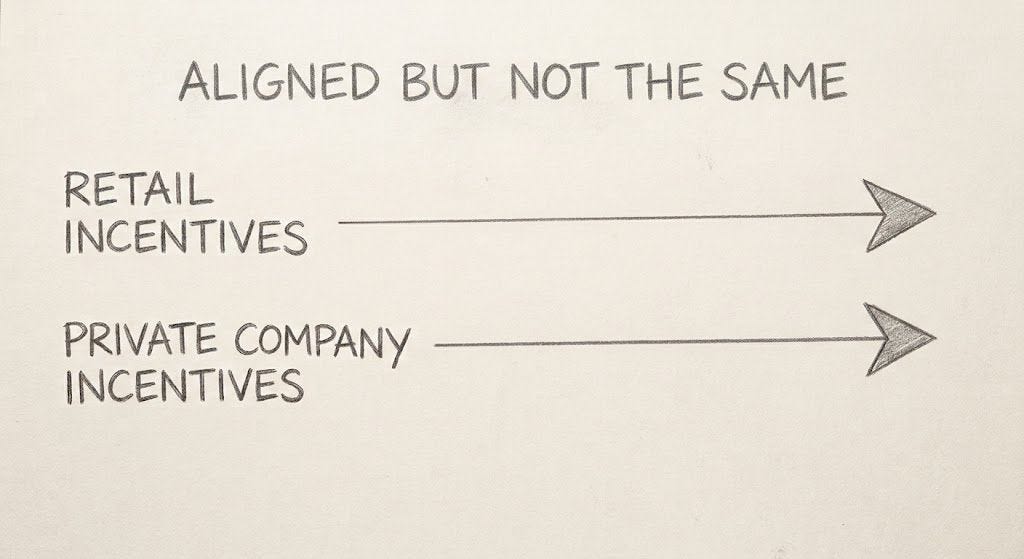
Fund managers are another prominent example. Both those invested in funds and the managers want the overall capital to go up. But their incentives don’t align forever. If it is beneficial for an investor to pull out their capital, the fund manager will be incentivized to recommend against that, as their fees are based on the amount invested.6
Aligned but not the same.
Back to our example with private companies going public, the incentives aren’t aligned here and that’s fundamental to understand. It’s the sad truth of the business world, sadly the parties around an IPO probably don’t care about you, only your capital. The only person who cares about your wealth is you and therefore you should become as informed as possible.
How does the IPO work?
When a company goes public, they only “float” or make public a certain percent of their shares. Most companies traditionally float between 25-40% of the company although the median float has lowered to 15.5% more recently.7 There are of course exceptions to the rule: SpaceX initially floated only 4-5% of their initial shares but that is a topic not for this article.
In any case, when a company announces that they are going public, they traditionally meet with underwriters (i.e. investment banks), institutional investors (large organizations with lots of money) and their board of directors to discuss the price the company will go public at.
When a company goes public the shares “floated” aren’t released to the general public immediately. Instead, investment banks agree to purchase and redistribute the shares from the company and therefore take the risk upon themselves. Institutional investors and retail investors then have to apply for an allocation in order to receive shares.
If more people apply for shares than existing shares, the stock will open higher than the price agreed upon. If fewer people apply for shares than what exists, the stock will trade initially lower than the price agreed upon.
Now, the incentives of all three of these parties are again, aligned but not the same. The first place the incentive aligns is that the company, underwriter and institutional investors all want the initial IPO price to be undervalued and a subsequent spike to occur.
The private companies want that because it validates that the company is cheap and a good investment - i.e. buy as quickly as possible, the company will never be this low again.
The investment banks want the IPO to spike because it provides instant profits with institutional investors, therefore strengthening their relationships. In addition, it makes future private companies more likely to pick them for an IPO, as they have a history of success.
The institutional investor wants the price to spike because it means their investments instantly spike and they are statistically likely to make money long term or sell at a profit.
And who fronts the bill for these three players? Retail investors.
In the next section, I will discuss how the cards are stacked against retail investors, what this means for you and how to avoid falling into a trap that you are statistically likely to lose money on.
For this week only, the yearly plan is 40% off. This subscription will include articles that save you money and all the benefits listed in this post. Thank you for your support.